
How Agentic AI Transforms Earth Observation Into Actionable Intelligence

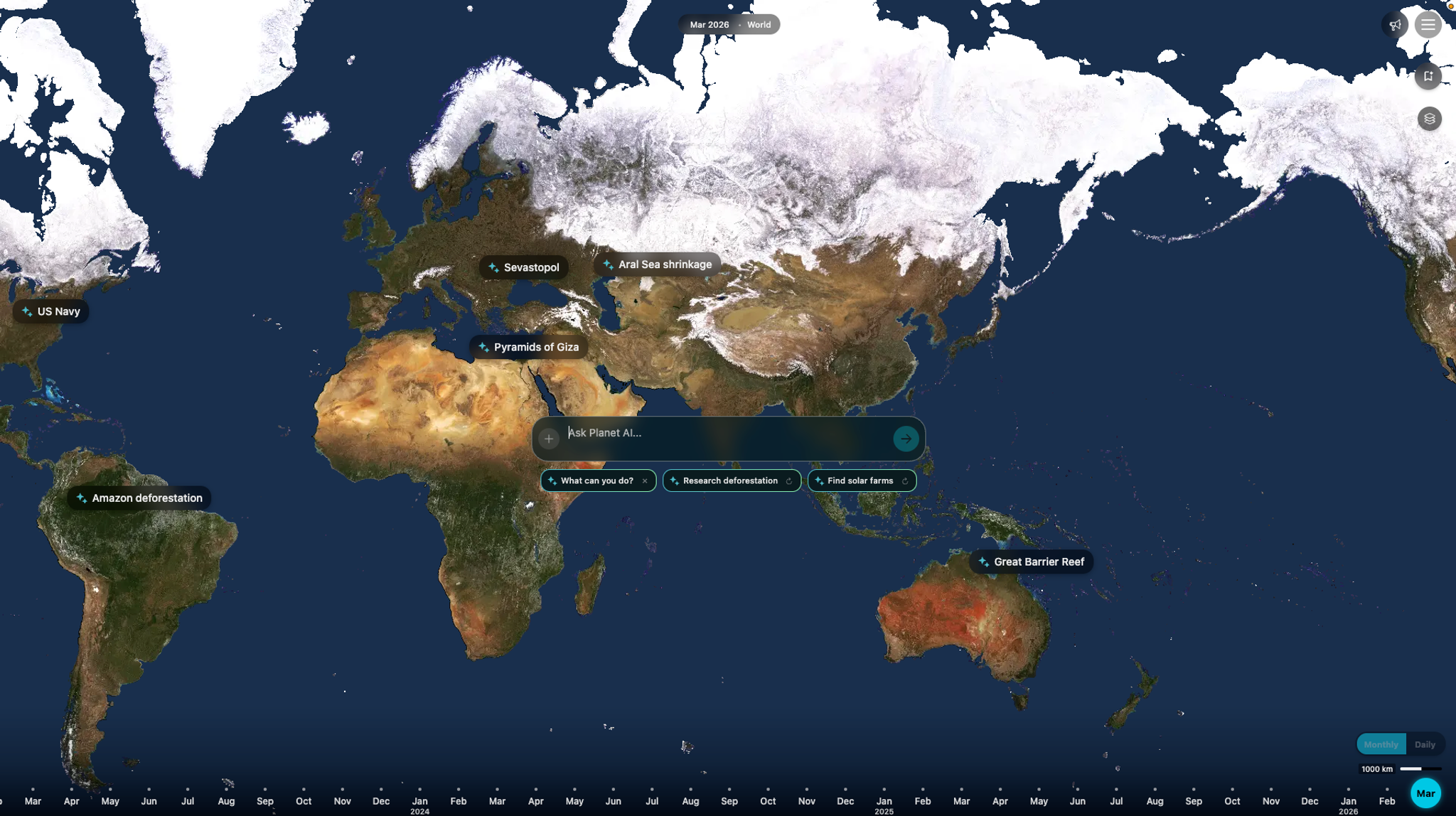
Where are new construction sites appearing across all of Florida?
This is a real query you can now type into Planet’s agentic geospatial AI (currently available in private beta), to receive a comprehensive answer.
No GIS expertise required. No manual image scanning. Just a question, and a report.
This new tool synthesizes satellite data, AI-enabled change detection, and public information in a simple, map-based chat interface — to give you geospatial insights, almost instantly. Let’s take a closer look at the vision for this powerful application, and how you can try it out, yourself.
The Shift Towards Planetary Intelligence
Earth observation (EO) data has never been more abundant. Every day, Planet constellations capture images of Earth’s land mass and 20 million square kilometers of open water, generating a constantly updated global dataset. This archive, which includes eight years of near-daily scans of the Earth, contains the answers to many of our most pressing global challenges, from monitoring supply chain disruptions to tracking the impacts of climate change.
However, for most organizations, the bottleneck isn't a lack of data; it's the time to insight. Conventional methods often require a combination of geospatial expertise and time-consuming manual processes. And by the time an analyst downloads, processes, and interprets an EO dataset, precious days or even weeks may have passed.
To turn data into actionable, timely insights, Planet is building towards a vision of Planetary Intelligence. This involves integrating AI across the entire value chain, from edge compute onboard satellites to Large Earth Models (LEMs) trained on our unrivaled data archive.
In the same way that Large Language Models (LLMs) have been trained on the text of the internet to understand human language, we envision a future where a new kind of AI model is trained on Earth observation data about the physical world. This Planetary Intelligence will understand the difference between normal variation and meaningful anomalies and empower humanity to make better decisions in response to change.
And a significant leap towards realizing this vision is agentic geospatial AI. Unlike traditional supervised machine learning, which provides specific, predefined outputs, agentic systems enable users to automate complex, multi-step processes using natural language. Pairing Planet data with agentic AI makes discovering insights about the planet as easy as asking a question, delivering Queryable Earth™.
Loading Video...
This demonstration showcases our emerging agentic geospatial AI. In this example, the agent focuses on construction sites in Florida. It autonomously navigates the map to locate specific points of interest immediately based on a simple natural language question.
Accelerating Decision Loops With Simple Queries and Deep Research
The demo above shows what that looks like in practice. You open Planet’s AI chat interface and type a question, Find construction sites in Florida, and the agent goes to work.
It searches Planet’s imagery archive, identifies matching locations, and highlights them on the map. For quick questions, you get results in seconds.
For deeper investigations, the agent shifts into a research mode: analyzing sites over time, interpreting visual features like cleared land, new foundations, or heavy equipment, and compiling everything into a shareable report with embedded satellite imagery.
This ability to launch powerful agentic workflows from an intuitive chat interface enables three critical shifts in how organizations and agencies can handle EO data:
- Democratized Access: By using natural language, stakeholders who are not geospatial experts — such as insurance adjusters, infrastructure managers, or civil government officials — can directly explore site-specific changes.
- Rapid Discovery: Instead of manually scanning thousands of square kilometers, users can instruct the AI to find specific activities, such as "areas that turned from farmland to development in Florida." The agent identifies the geometry, conducts the search, and highlights the relevant imagery.
- Synthesized Reporting: Perhaps the most powerful application is Deep Research mode. In this workflow, the agent doesn't just find an image; it takes multiple steps to analyze a site over time, interprets visual features, such as identifying orange cranes or steam plumes at industrial facilities, and synthesizes these findings into a report.
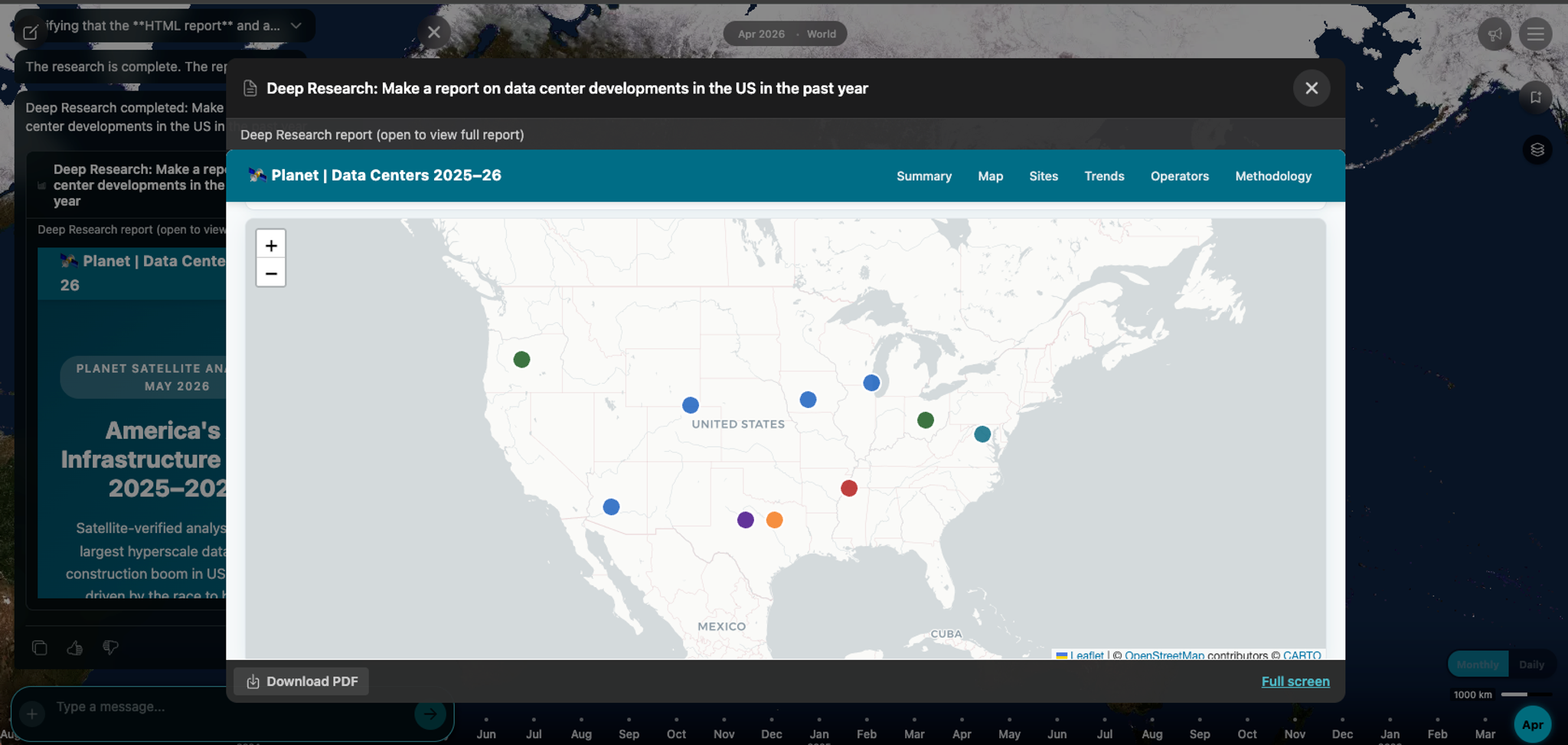
The deep research mode synthesizes satellite imagery and public data into professional, detailed reports in a fraction of the time. This shows an example of data center construction in the United States.
And ultimately, by automating complex geospatial processing that once took days or weeks, Agentic AI compresses decision loops into minutes. This capability allows organizations to understand and respond to our changing planet in near-real time, and transition from reactive monitoring to proactive management.
Whether verifying cooling tower construction in industrial hubs or monitoring oil terminal activity, the combination of a frequent data foundation and agentic reasoning delivers analysis at a level of scale and complexity that was previously impractical.
Queryable Earth Is Open for Prompts!
To see these workflows in action and learn more about the vision of our AI initiatives, watch our latest Agile EO webinar. Our product experts share how Planet envisions using AI to democratize access to vital geospatial information, and a first look at the map-based interface.
And we are currently accepting participants for our private beta. Join the waitlist to get hands-on experience with the agentic geospatial chat app and have the opportunity to influence the future of the product.
Forward-Looking Statements
This blog contains forward-looking statements within the meaning of Section 27A of the Securities Act of 1933, as amended, and Section 21E of the Securities Exchange Act of 1934, as amended. Forward-looking statements generally relate to future events or Planet’s future financial or operating performance. In some cases, you can identify forward-looking statements because they contain words such as “expect,” “estimate,” “project,” “budget,” “forecast,” “target,” “anticipate,” “intend,” “develop,” “evolve,” “plan,” “seek,” “may,” “will,” “could,” “can,” “should,” “would,” “believes,” “predicts,” “potential,” “strategy,” “opportunity,” “aim,” “conviction,” “continue,” “positioned,” “structured” or the negative of these words or other similar terms or expressions that concern Planet’s expectations, strategy, priorities, plans or intentions.
Forward-looking statements in this blog include, but are not limited to, statements regarding Planet’s financial guidance and outlook, expected financial and operating results, the expected value of contracts that Planet has entered into and the timing and amount of revenue that Planet will recognize, Planet’s growth opportunities, Planet’s expectations regarding future product development and performance, including with respect to AI, Planet’s expectations regarding the launch and operations of its satellites, including with respect to timing, and Planet’s expectations regarding its strategies with respect to its markets and customers, including trends in customer demand. Planet’s expectations and beliefs regarding these matters may not materialize, and actual results in future periods are subject to risks and uncertainties that could cause actual results to differ materially from those projected, including risks related to the macroeconomic environment and risks regarding Planet’s ability to forecast Planet’s performance due to Planet’s limited operating history. The forward-looking statements contained in this blog are also subject to other risks and uncertainties, including those more fully described in Planet’s filings with the Securities and Exchange Commission (“SEC”), including Planet’s Annual Reports on Form 10-K, Quarterly Reports on Form 10-Q, and any subsequent filings with the SEC that Planet may make. All forward-looking statements reflect Planet’s beliefs and assumptions only as of the date of this blog. Planet undertakes no obligation to update forward-looking statements to reflect future events or circumstances, except as may be required by law.

Ready to Get Started
Connect with a member of our Sales team. We'll help you find the right products and pricing for your needs.