How Mahindra Uses Planet Monitoring to Transform Sugarcane Harvest Planning in India

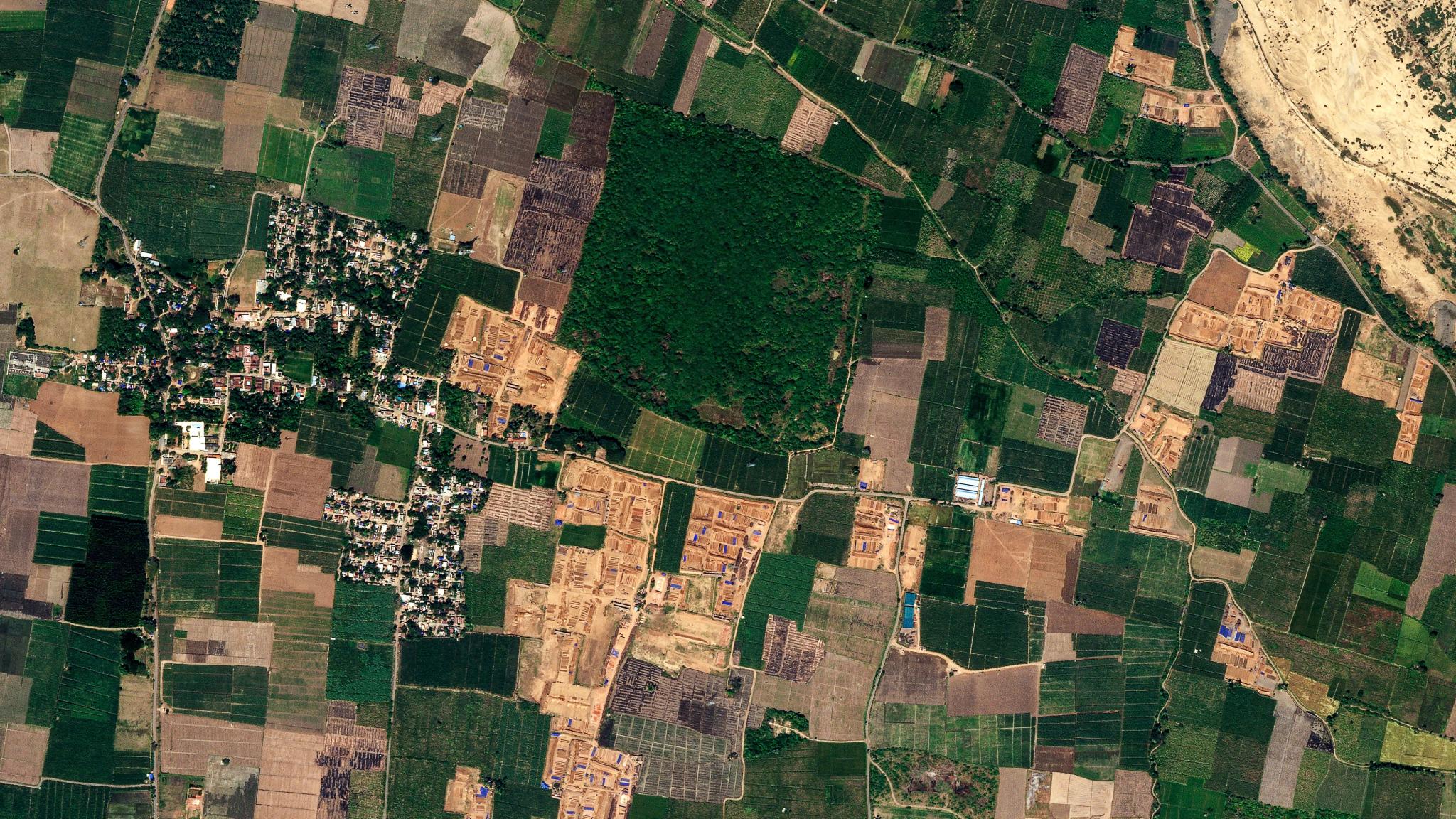
SkySat® image of sugarcane fields in India, captured on February 10, 2023. © 2023, Planet Labs PBC. All rights reserved.
StoriesThe sugarcane industry in India is the second largest in the world, with over 450 million metric tons produced annually from roughly 5.9 million hectares, sustaining over 50 million farmers.
Despite this success, harvesting practices have historically been based on the calendar, instead of plant maturity. This approach, exacerbated by climate volatility, has led to a decline in sugar recovery — the percentage of usable sugar obtained from sugarcane during the milling process.
Mahindra and Mahindra Limited, the world’s largest tractor manufacturer (by volumes) and a leader in India’s farm mechanization growth journey, is addressing this issue with satellite imagery. With Planet near-daily data, they are helping sugar mills transition from age-based harvesting to a maturity-based model to boost farm efficiency and prosperity across India.
The Challenge: Managing 40,000 Individual Plots
India’s sugar recovery over the last two years has been consistently declining. Premature harvest of sugarcane driven by competition, shortage of cane to meet crushing capacity, and limited visibility into field-level operations is leading to shrinking sugar recovery.
This premature harvesting equates to revenue loss, which determines whether a mill stays solvent. Low recovery means low sugar production from the same sugarcane area, and a direct hit on the bottom line of sugar mills in an industry with relatively thin margins.
A complete and current picture of crop health is needed to ensure crops are harvested at the right time to maximize recovery rates. But there are over 5 million hectares of sugarcane fields in India across small, fragmented farms with an average one hectare plot size. So monitoring crop health and maturity at scale is an enormous challenge.
Traditionally, sugar mills relied on manual field scouting or drones. But these processes are slow or prone to data gaps. Public satellite data can help, but does not have the frequency or resolution needed to understand growth in every small field. And as a result, mills historically have resorted to a calendar-based approach to harvesting instead of a data-driven, maturity-based model.
The Solution: Continual, Quality Satellite Imagery
To create an actionable understanding of crop health Mahindra is using PlanetScope® imagery, which offers two key capabilities:
- High frequency: The near-daily revisit rate of PlanetScope imagery helps mitigate the limitations posed by cloud cover to a significant extent. During the monsoon season, when persistent cloud cover constrains the usability of optical imagery, the integration of PlanetScope data with Synthetic Aperture Radar (SAR) ensures the continuity, reliability, and accuracy of outputs.
- Detailed granularity: PlanetScope 3 meter resolution identifies underperforming areas, prompting actions like targeted pest control for early shoot borer or rust infestations before they spread.
Mahindra integrates these satellite insights directly into mill ERP systems and management dashboards. This creates an optimized harvesting schedule based on the mill’s actual crushing capacity and the crop’s biological readiness.
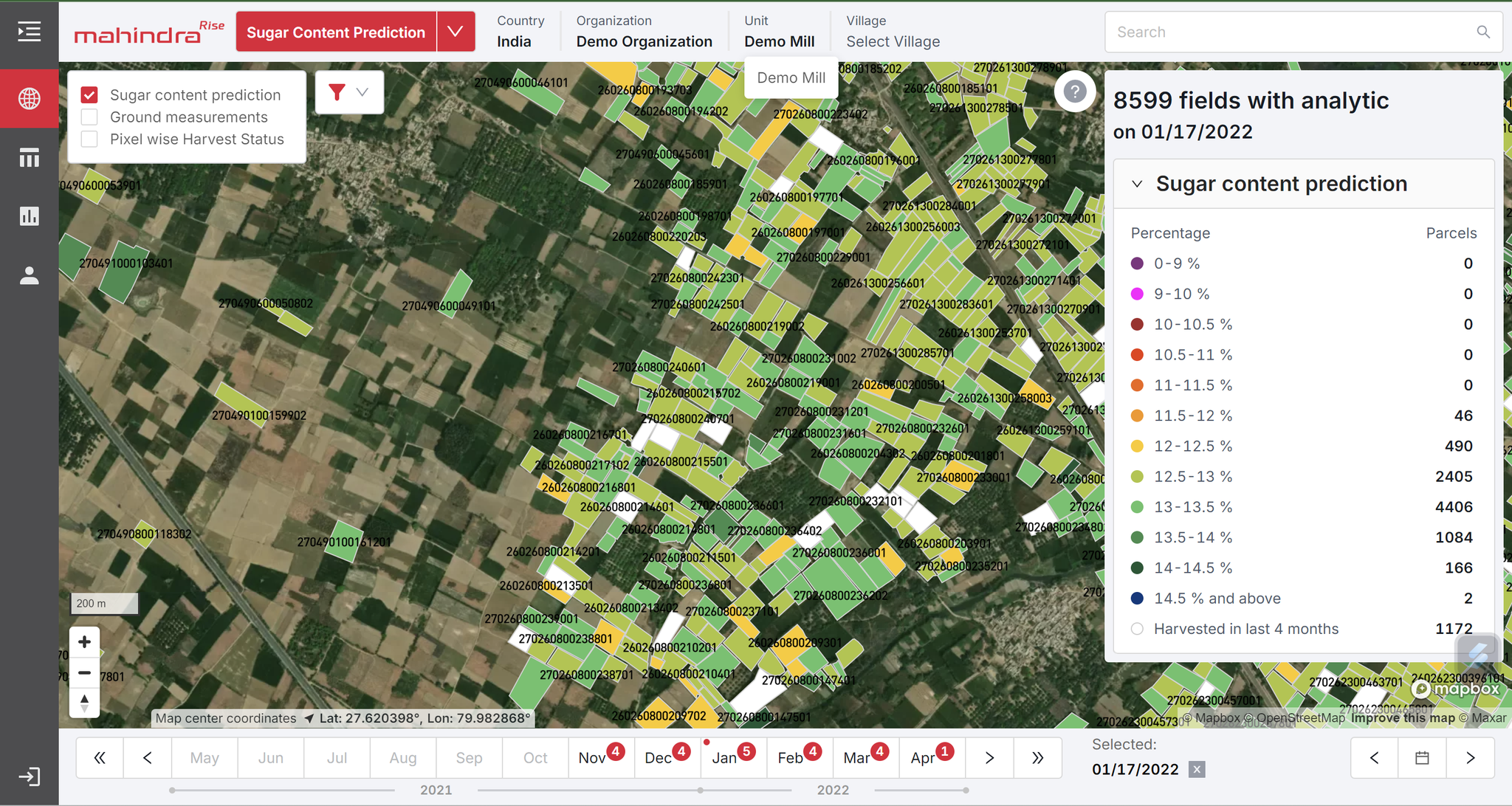
Mahindra’s sugar content prediction analysis tool.
Sugar recovery is highly dynamic; any change in crop practices like irrigation, or shifts in weather, can have a significant impact. Harvest and crushing decisions are made weekly, and predictions are aligned accordingly. Monthly intervals would make sugar recovery estimates obsolete. Mahindra is now exploring the possibility of reducing prediction cycles from weekly to every two to three days, leveraging higher-frequency imagery and weather data.
The Results: A Proven ROI for the Sugar Industry
The transition from non-systematic, data-blind operations to a data-backed, maturity-based harvest model has delivered quantifiable success to sugarcane mills across several areas:
- Maximized profit: Mahindra shared that it has been a journey from data-blind operations to AI-led revolution. The initial year or two of engagement with a mill focus is on streamlining the data quality and accuracy. As they continue the engagement, the quality of input data and the mill's ability to implement strict harvesting schedules could lead to a substantial increase in sugar recovery. These increases could translate into up to INR 17.5 million incremental profit for every 0.1% increase in sugar recovery at mills crushing 0.5 million tons, assuming a sugar price of INR 35 per kilogram.
- Operational scale: Monitoring thousands of plots simultaneously has removed the need for costly drone flights or labor-intensive manual scouting.
- Sustainability and precision: Detecting stress at high resolution allows farmers to use inputs like water and fertilizer more effectively, reducing the pressure to expand acreage, protecting vital resources.
This innovative approach shows that profitability and sustainability can go hand in hand. By using data to guide harvest decisions, mills can boost returns while reducing the need for additional land, water, and inputs.
Do More With Planet Data
Mahindra’s success demonstrates how high-frequency Earth data can transform traditional processes into precision powerhouses. And this approach is relevant across the agriculture industry.
Interested in learning more? Read our e-book, From Imagery to Data Shifting Approaches in Digital Architecture.
These insights are based on an interview with Rucha Nanavati, Senior Vice President and Chief of Advanced Technologies – Farm Equipment Business at Mahindra, focusing on data-driven solutions to improve efficiency and sustainability in the sugar industry.