
Using Space to Help Life on Earth: A Progress Report

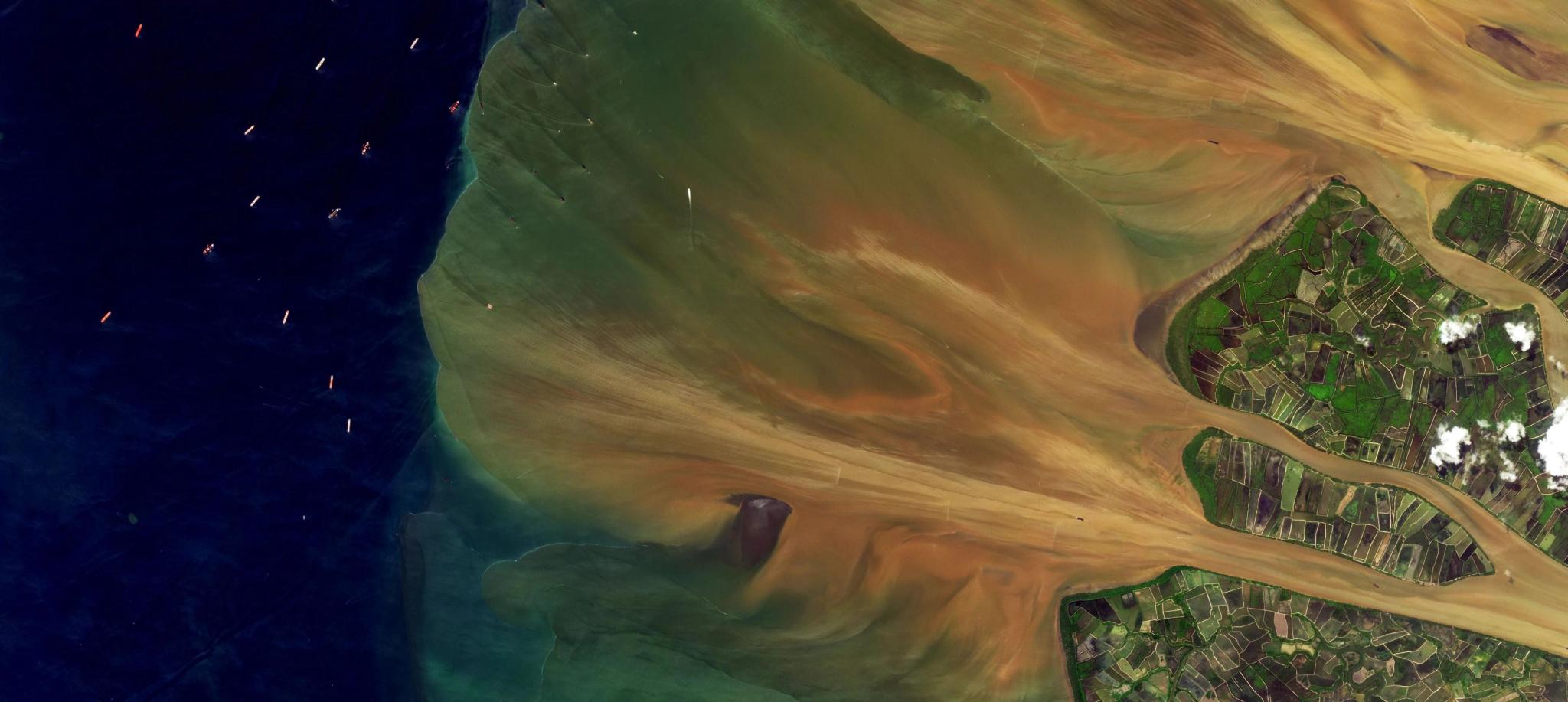
PlanetScope image of the Mahakam River and Makassar Strait in Indonesia, captured April 28, 2025. © Planet Labs 2025. All rights reserved.
NewsSince Planet’s founding in 2010, our company has been driven by a singular mission, to use space to help life on Earth. By imaging the Earth, every day, and making global change visible, accessible and actionable, we have sought to enable governments, companies, scientists, journalists, NGOs, communities and others to take coordinated, effective action to steward Spaceship Earth.
Our recently released Impact Report for Fiscal Year 2025 (FY25) is a detailed progress report on our fulfillment of this mission, containing rigorous metrics covering just some of the many ways our data, products, and services are being used to create lasting impact around the world. Here are some highlights.
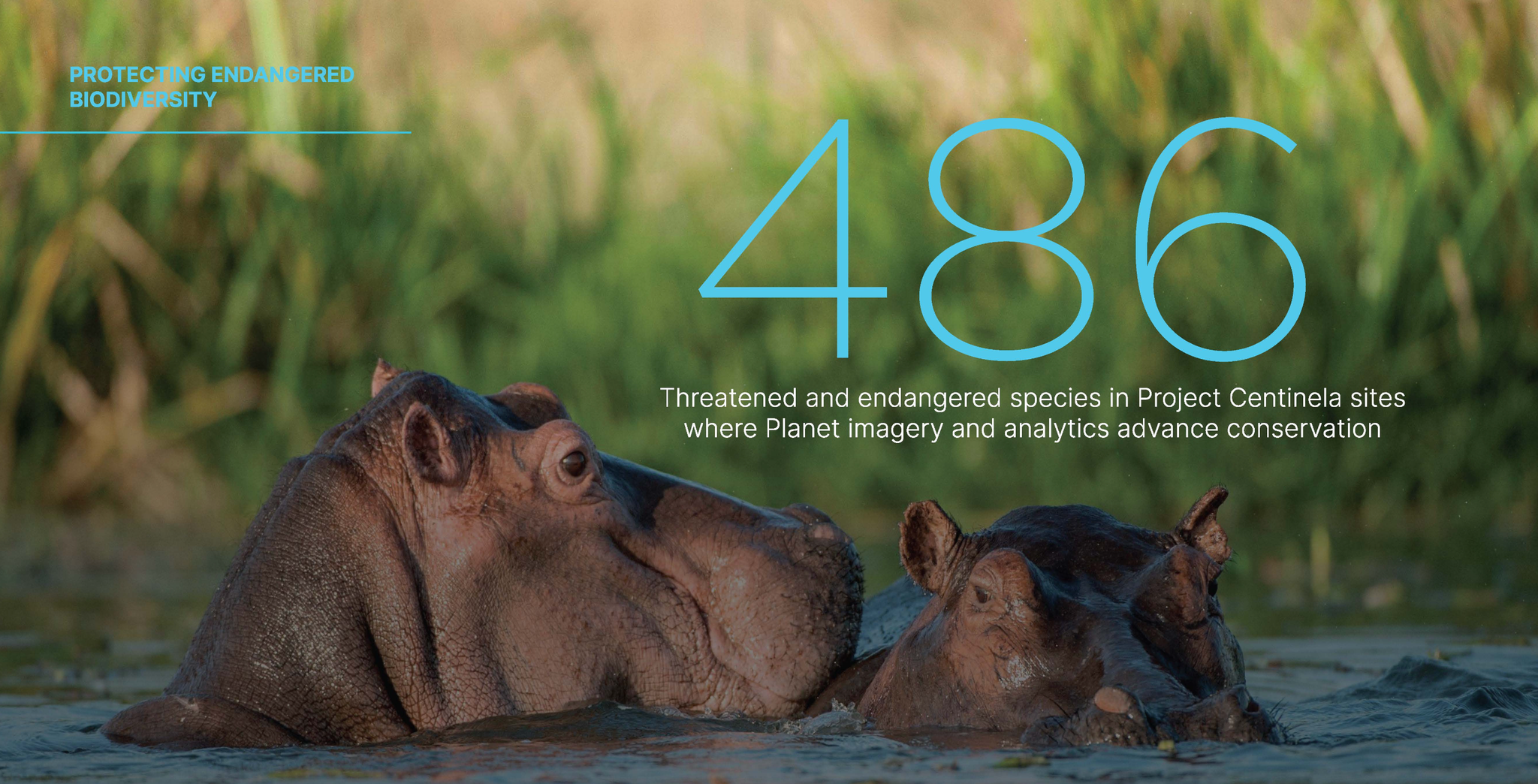
In FY25, Planet data, products and services were used to monitor biodiverse hotspots around the world.
In FY25, through our Project Centinela program, frontline conservationists worked to support the protection of more than 486 threatened and endangered species in critical biodiverse hotspots across the globe. In the same period, more than 4,000 media pieces using Planet imagery were filed by journalists worldwide — including ones that won the Emmy, Peabody, and Pulitzer Prizes.
Meanwhile, Planet data was used to support hundreds of environmental compliance enforcement actions in the Amazon, helping to stem the tide of deforestation. And with broad access, scientists around the world continued to use our data to revolutionize our understanding of the Earth itself — an academic paper citing Planet data is now published more than three times a day, and rising.
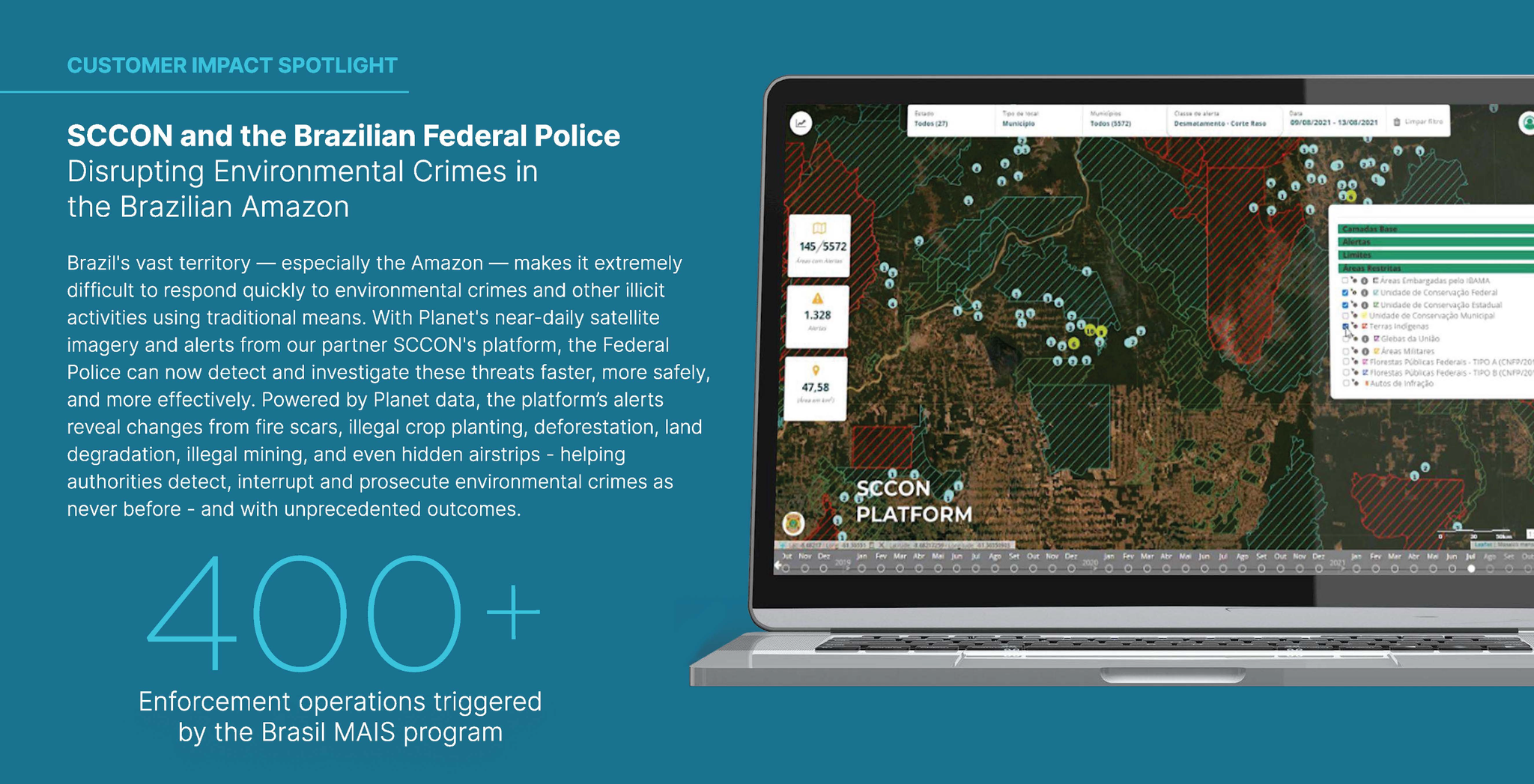
Planet partner SCCON used Planet imagery to enable more than 400 environmental enforcement actions in the Amazon, supporting a 54% reduction in deforestation in affected areas.
In FY25, Planet also invested more than 11 petabytes of data into collaborative efforts to build digital public goods in areas as diverse as mapping renewable energy and responding to crises and disasters. For example, collaborating with Microsoft’s AI for Good Lab, Planet supported a comprehensive building damage assessment for the Eaton fire in Los Angeles, revealing that 8,682 structures had been damaged by the fire, and informing ongoing response efforts.
Planet’s technologies also helped surface risks early, before they fully escalated into crises. Our partner CarbonMapper used Tanager-1, the world’s most advanced hyperspectral satellite, to spot, and help close, a massive methane plume, leaking 7,000 kilograms of methane per hour, in Texas’s Permian Basin.
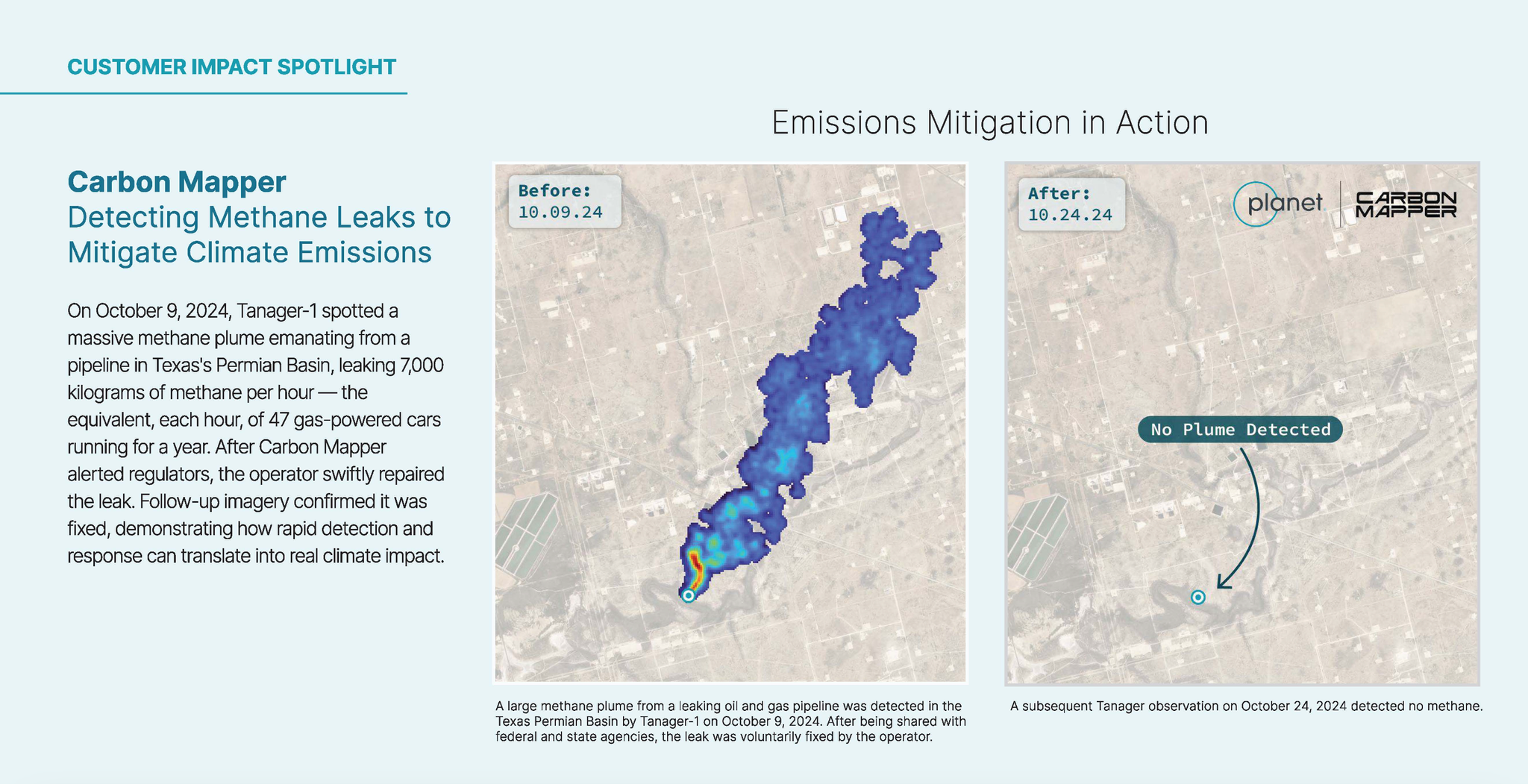
On October 9, 2024, Tanager-1 spotted a massive methane plume emanating from a pipeline in Texas's Permian Basin.After Carbon Mapper alerted regulators, the operator swiftly repaired the leak.
These and many similar real-world results highlighted in the report inspire us, as we hope they similarly inspire you. They also motivate us to strive harder, because we know only a small fraction of the potential impact of our data, products and services has yet been realized.
Fulfilling that ambition is not only one of Planet’s strongest cultural values, but a key aspect of our structure and governance as well. In 2021, as we listed on the New York Stock Exchange, Planet became a Public Benefit Corporation (or PBC). This status locks in our values, making us not only mission-aligned but mission-accountable. It helps us attract exceptional talent, build trust with diverse partners, and sustain a culture where ethics guide our business decisions. It also helps us balance short-term pressures with long-term goals.
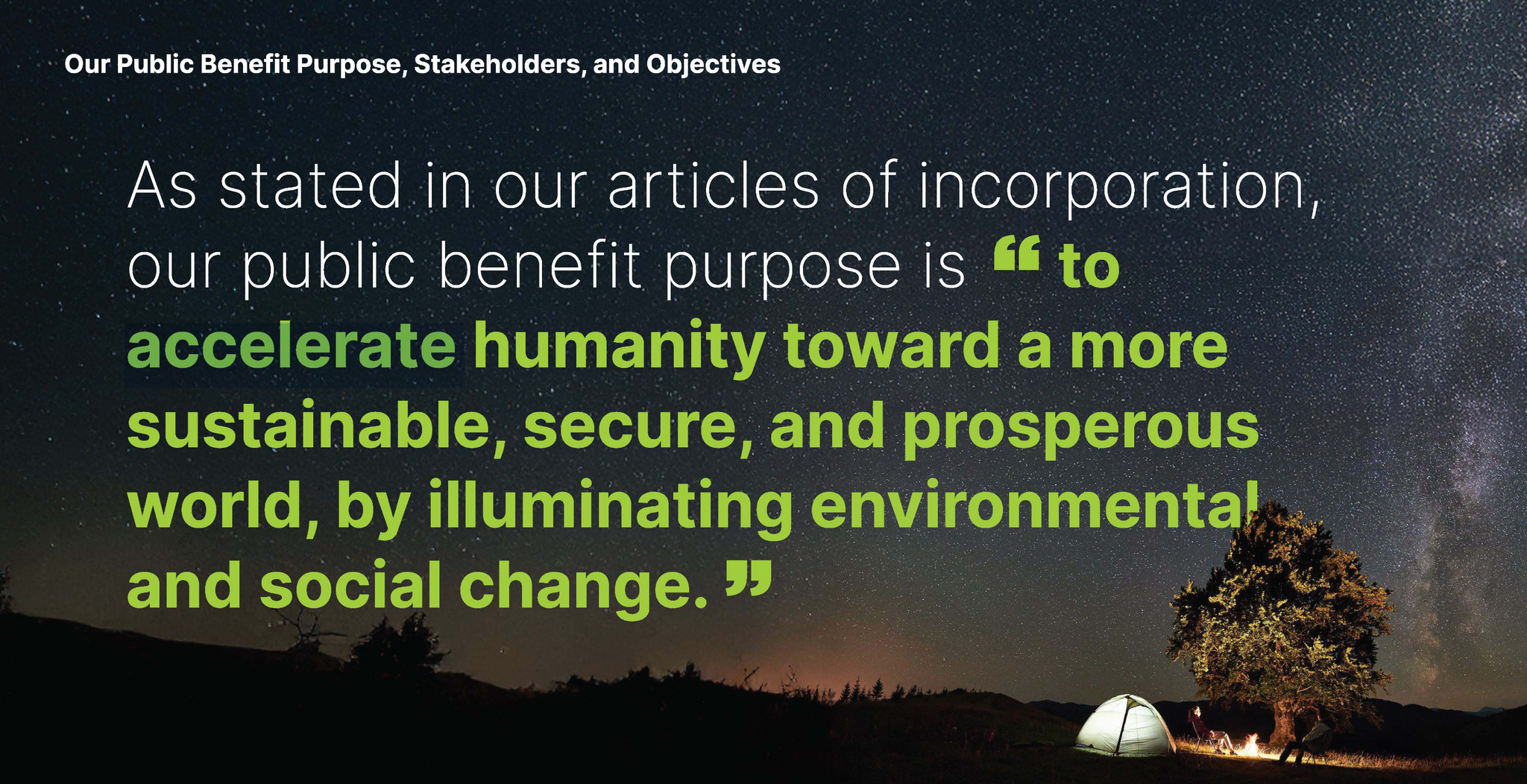
Planet’s Public Benefit Purpose informs all elements of our business strategy and operations.
As a PBC, we are legally bound to balance our traditional fiduciary duties with those of a broader group of stakeholders, in service of our public purpose, which is “to accelerate humanity toward a more sustainable, secure, and prosperous world by illuminating environmental and social change.”
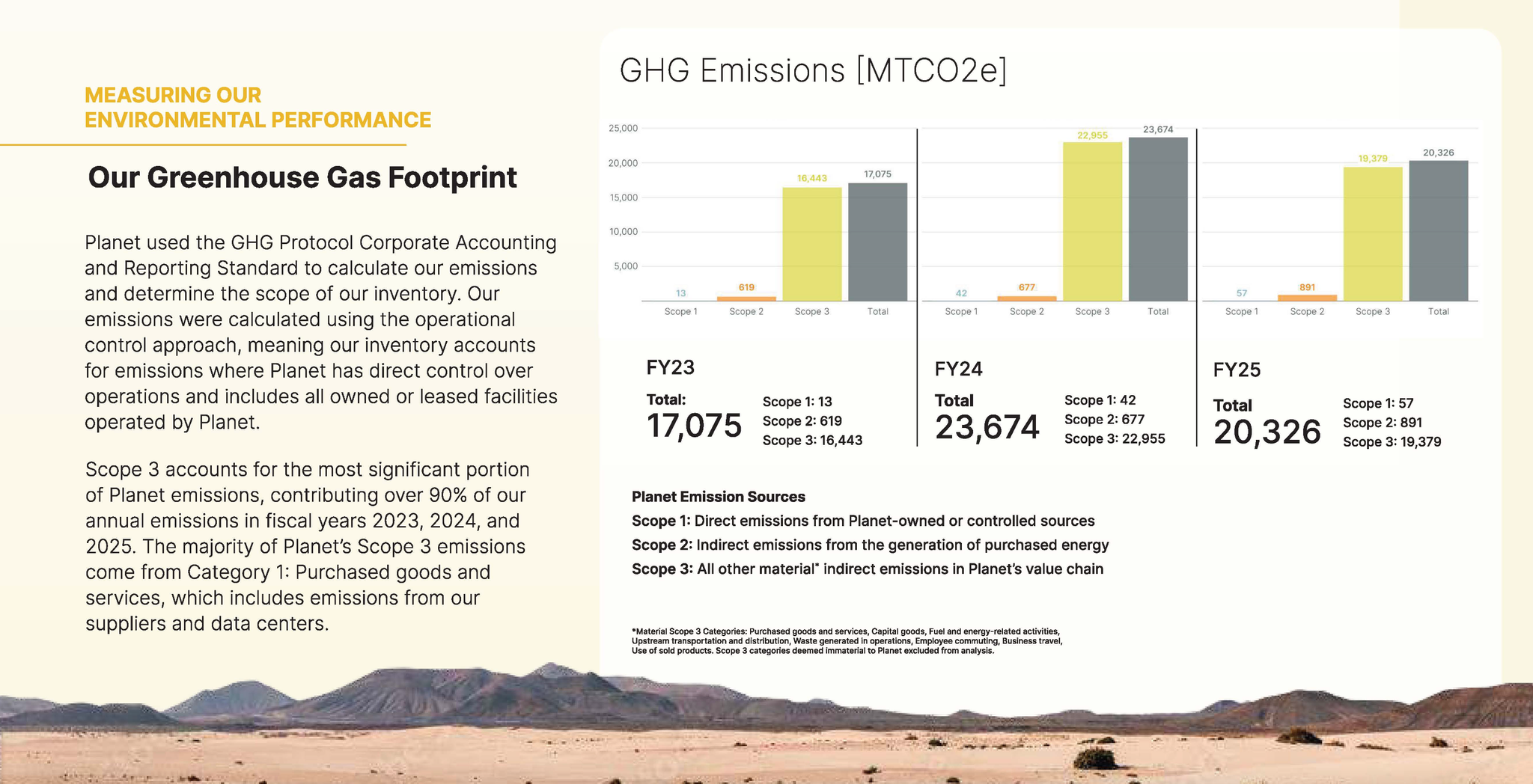
Planet’s year-on-year Scope 1, 2 and 3 emissions are independently assessed and reported annually.
The report also details our efforts to deliver on that promise while operating transparently, sustainably, and ethically. It details our independent, environmental accounting of the full costs of our operations, and the ways in which we think about sustainability and ethics, reaching from here on Earth all the way to orbit.
The impact that Planet creates is not ours alone. It belongs, principally, to those on the front lines, who use our tools to act wisely and effectively. Every datapoint in the Impact Report reflects their choices — the work of customers, policymakers, scientists, conservationists, journalists, humanitarians, and Planet team members.
This report is both an accounting of their impact and an invitation to learn from, and hold us accountable to, the mission we share. As valued Planet stakeholders, we hope you enjoy reading it!

Ready to Get Started
Connect with a member of our Sales team. We'll help you find the right products and pricing for your needs.